Owning a home is a major financial milestone, but for many entrepreneurs, freelancers, and business owners in Nigeria, getting a mortgage can feel difficult. Unlike salaried employees who receive fixed monthly income and pay slips, self-employed individuals often have irregular income streams, which can make lenders more cautious.
However, being self-employed does not mean you cannot qualify for a mortgage. With the right financial preparation and documentation, many business owners successfully secure home financing.
This guide explains how mortgages work for self-employed individuals and how you can improve your chances of approval.
What Is a Mortgage?
A mortgage is a loan provided by a financial institution that allows you to buy a property while paying for it over a long period of time. Instead of paying the full amount upfront, you make an initial down payment and repay the remaining balance in installments.
The property itself usually serves as collateral until the loan is fully repaid.
Mortgages can make property ownership more accessible, especially in cities where property prices are high.
Can Self-Employed Individuals Qualify for a Mortgage?
Yes, self-employed individuals can qualify for mortgages in Nigeria. However, lenders need clear proof that you have stable income and the ability to repay the loan.
Since self-employed individuals may not have payslips, lenders rely on other financial records to assess income stability.
This is why maintaining proper financial documentation is extremely important.
Key Requirements for Self-Employed Mortgage Applicants
1. Bank Statements
Most lenders will request 6 to 12 months of bank statements to review your financial activities.
These statements help lenders determine:
The consistency of your income
Your business cash flow
Your financial discipline
Regular income deposits and responsible spending patterns improve your chances of approval.
2. Business Registration Documents
Lenders may require proof that your business is legitimate and properly registered.
Common documents include:
CAC Registration Certificate
Business Name Registration
Tax Identification Number (TIN)
Having these documents shows that your business operates legally.
3. Tax Clearance Certificate
Tax compliance is often required when applying for a mortgage.
A tax clearance certificate for the past 2–3 years helps demonstrate that your income is genuine and verifiable.
4. Proof of Income
In addition to bank statements, lenders may request supporting evidence such as:
Business invoices
Contracts with clients
Financial records or profit statements
These documents help lenders understand how your business generates income.
5. Down Payment
Most mortgage lenders require a down payment, usually between 10% and 30% of the property value.
For example:
If a property costs ₦50,000,000 and the lender requires a 20% down payment, you will need to pay ₦10,000,000 upfront while the mortgage covers the remaining balance.
Common Challenges Self-Employed Buyers Face
While mortgages are possible for entrepreneurs, some challenges can arise if financial records are not well organized.
Common issues include:
Irregular bank transactions
Mixing personal and business finances
Lack of proper documentation
Inconsistent income records
These factors can make lenders hesitant.
How to Improve Your Chances of Mortgage Approval
If you are self-employed and planning to apply for a mortgage, these steps can help strengthen your application:
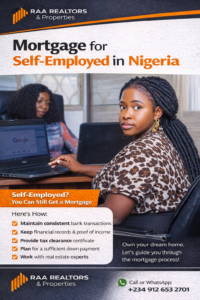
Maintain consistent banking activity Regular deposits and proper financial records demonstrate income stability.
Separate personal and business accounts This makes it easier to track business income and expenses.
Keep proper financial records Accurate documentation helps lenders evaluate your financial capacity.
Pay your taxes regularly Tax compliance increases credibility with financial institutions.
Work with experienced real estate professionals Guidance from knowledgeable professionals can help you find mortgage-friendly properties and lenders.
Why Professional Guidance Matters
Navigating mortgage requirements can be complex, especially for self-employed individuals. Working with experienced real estate professionals helps you avoid costly mistakes and identify properties that qualify for mortgage financing.
At RAA Realtors & Properties, we guide clients through the property buying process and help connect them with mortgage opportunities that match their financial situation.
Final Thoughts
Being self-employed should not prevent you from owning a home. With proper financial planning, organized documentation, and the right guidance, securing a mortgage is achievable.
If you are a business owner, freelancer, or entrepreneur planning to buy property, understanding mortgage requirements is the first step toward making that dream a reality.
About Raa Realtors N Properties
Raa Realtors N Properties is a Lagos-based real estate company specializing in verified land sales, property acquisition, and real estate advisory services across Lagos.
We help individuals, families, and diaspora investors safely buy land and properties with proper documentation, government-recognized titles, and transparent processes.
Our core services include:
* Buy verified land in Lagos
* Property documentation & verification
* Land banking opportunities
* Residential and commercial property sales
* Real estate investment advisory
With a strong commitment to due diligence, transparency, and client protection, we ensure every property transaction is secure and legally compliant.